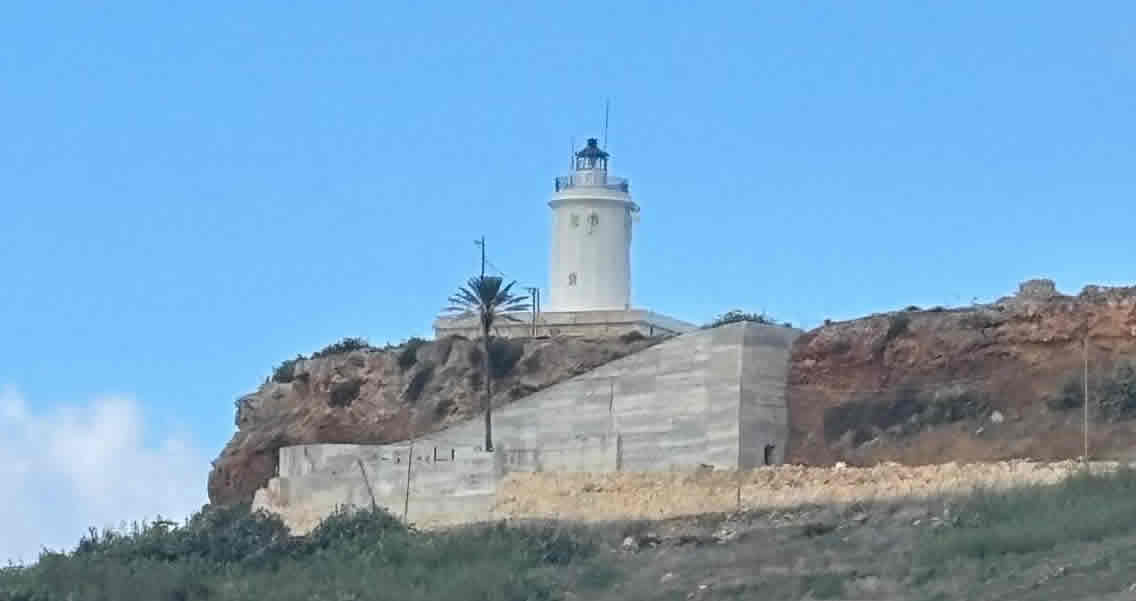
Gordan Lighthouse
Gordan Lighthouse, also known as Ta’ Ġurdan, Giordan Lighthouse and Il-Fanal ta’ Ġurdan, stands on the summit of Ġurdan Hill above the village of Għasri in northwestern Gozo.
The lighthouse occupies one of the highest and most exposed positions in this part of the island. Its elevated location gives the light a focal height of about 180 metres above sea level and gives visitors extensive views across Gozo and the surrounding Mediterranean.
Before the present lighthouse
The site has a much older navigational history than the present tower. A light at Ġurdan Hill is recorded in 1667, associated with the Knight Fra Henry de Gourdan of the Langue of Auvergne.
The elevated hill was a natural choice for a navigational light. A beacon placed here could be seen from far out at sea and helped vessels approaching the Maltese Islands identify the coast.
Construction of the present lighthouse
The present lighthouse was built during the period of British rule, when the growing volume of maritime traffic created a greater need for reliable navigation around Gozo's northern and western coastline.
Construction works began in June 1852. The lantern was inaugurated by Sir William Reid, Governor of Malta, on 15 March 1853, when it operated with an oil light.
The Ghasri Local Council records that a residential quarter for the lighthouse watchmen was subsequently added and that the complete project was officially inaugurated by Sir William Reid on 11 October 1857. The different dates reflect the lighting of the lantern and the later completion of the wider lighthouse station.
The lighthouse building
The tower is a white cylindrical stone structure rising from a two-storey square stone building. The lower building provided the accommodation and working spaces needed by the lighthouse keepers, while the tower carried the lantern and gallery.
The lighthouse tower is about 21–22 metres high. Its great navigational advantage comes not from the height of the masonry tower alone, but from its position on Ġurdan Hill.
The result is a prominent landmark that can be recognised from many parts of Gozo and forms one of the defining features of the Għasri landscape.
The original light
The original system used oil lamps and reflectors. The Ghasri Local Council records that the lighthouse later operated with 21 fixed kerosene lamps whose light was directed onto a rotating reflector.
A surviving schematic described by Din l-Art Ħelwa shows 21 reflectors mounted on a triangular rotating base, with seven reflectors on each side. This system was designed to produce a powerful rotating beam visible over a considerable distance.
The lighting apparatus was modernised over time as lighthouse technology developed. The station eventually became automated in 1994.
Gordan Lighthouse during the Second World War
Ġurdan Hill was valuable during the Second World War because of its commanding position. The lighthouse site was used for an early-warning radar and observation role, helping monitor aircraft and maritime activity around Gozo.
The wartime use added another chapter to the history of a site that had already served navigational purposes for centuries. The height that made the lighthouse effective for ships also made the hill useful for observing the wider area.
A lighthouse that became a scientific station
The site has an important modern scientific role as well as its navigational function. The lighthouse station forms part of the Global Atmosphere Watch network and is used for background atmospheric monitoring in the central Mediterranean.
Instruments associated with the University of Malta measure atmospheric pollutants and trace gases at the elevated site. The station was upgraded during the period 2008–2011, strengthening its role as a long-term scientific monitoring location.
The views from Ġurdan Hill
Even if the lighthouse itself is not open for entry, the hilltop is one of the best places in this part of Gozo for a wide panoramic view. From around the lighthouse there are open views towards the coast, Għasri, Għarb, Żebbuġ and the surrounding countryside.
The elevated position also makes the site especially attractive for photographers and walkers. The landscape changes with the seasons, with green agricultural fields in winter and spring giving way to the warmer golden colours of summer.
Gordan Lighthouse and Għasri
The lighthouse dominates the skyline above Għasri, Gozo's smallest village. The surrounding countryside contains traditional fields, rubble walls and rural tracks leading towards Wied il-Għasri and the northwestern coast.
A visit to the lighthouse can therefore be combined with a walk through the countryside and a visit to Wied il-Għasri, where the valley cuts through the limestone before reaching the sea.
What to see around Gordan Lighthouse
Photographs
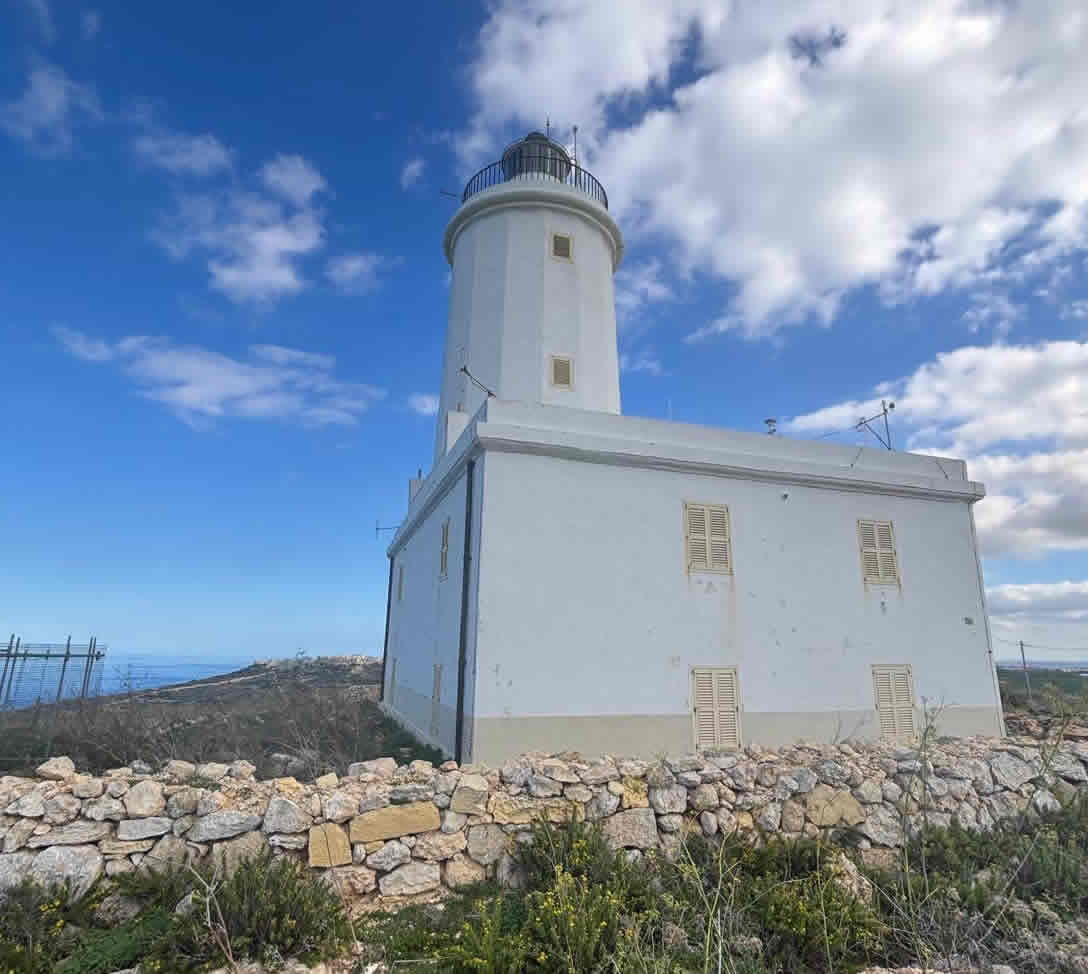
Gordan Lighthouse, Ġurdan Hill
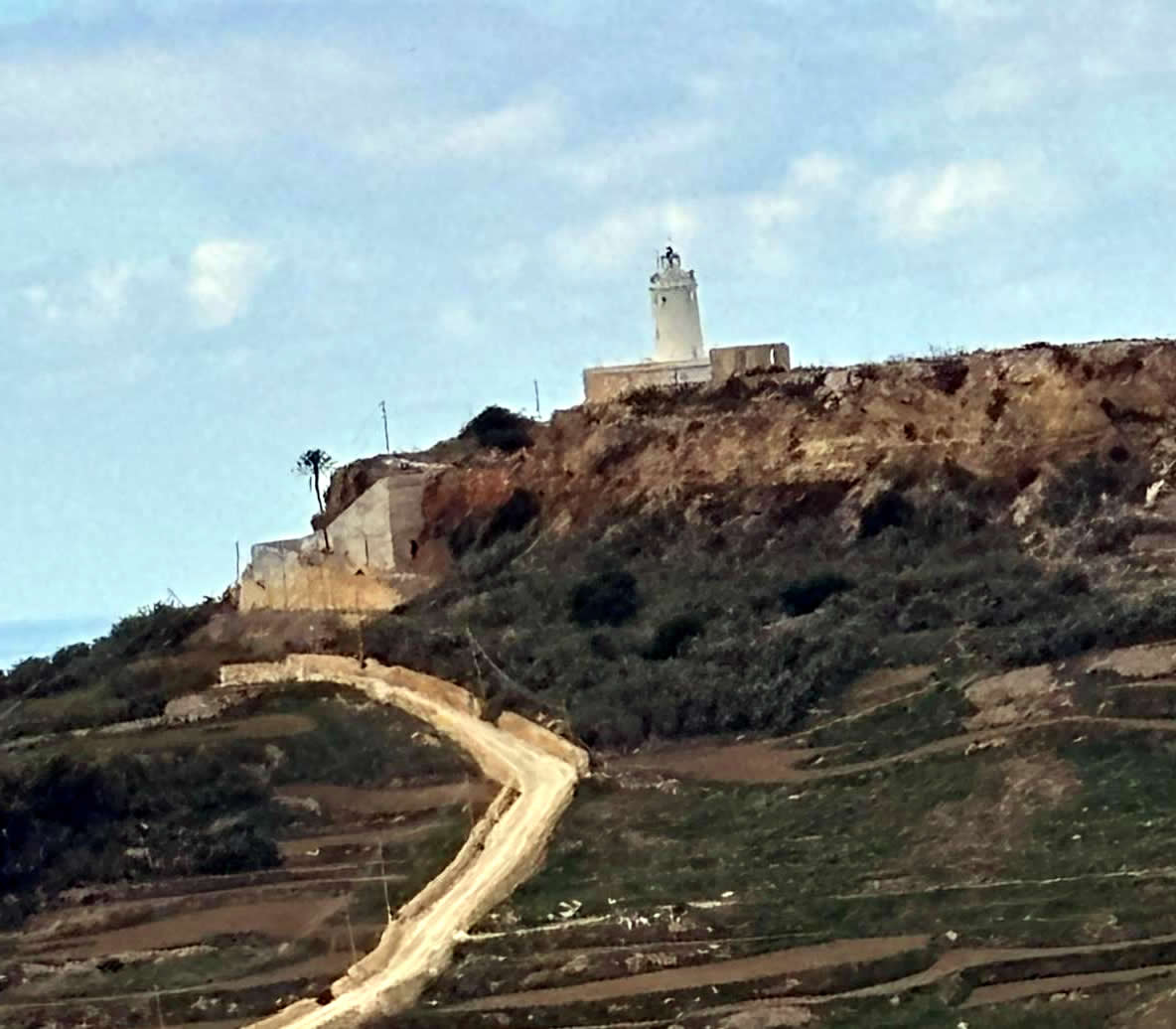
Views from Ġurdan Hill below the lighthouse
Location
Ġurdan Hill
Għasri, Gozo
Malta
Gordan Lighthouse stands on the summit of Ġurdan Hill above Għasri in northwestern Gozo. The elevated position provides extensive views across the surrounding countryside and coastline.
Coordinates:
36.072314, 14.218406
Gordan Lighthouse FAQ
Where is Gordan Lighthouse?
Gordan Lighthouse stands on Ġurdan Hill above Għasri in northwestern Gozo.
When was Gordan Lighthouse built?
The present lighthouse was constructed in the early 1850s. The lantern began operating on 15 March 1853.
What is the lighthouse also called?
It is commonly known as Gordan, Giordan or Ta’ Ġurdan Lighthouse. The Maltese name is Il-Fanal ta’ Ġurdan.
How high is Gordan Lighthouse?
The tower itself is approximately 21–22 metres high, while its focal plane is about 180 metres above sea level because of the elevated position of Ġurdan Hill.
Is Gordan Lighthouse still active?
Yes. The lighthouse remains an aid to navigation, although it was automated in 1994.
Can you go inside Gordan Lighthouse?
Access to the tower interior is not guaranteed. The surrounding hilltop can still be visited for its views, but visitors should check current local arrangements before planning to enter the lighthouse.
What is the Global Atmosphere Watch station?
The lighthouse site is also used for long-term atmospheric monitoring as part of the Global Atmosphere Watch network, providing scientific measurements for the central Mediterranean.