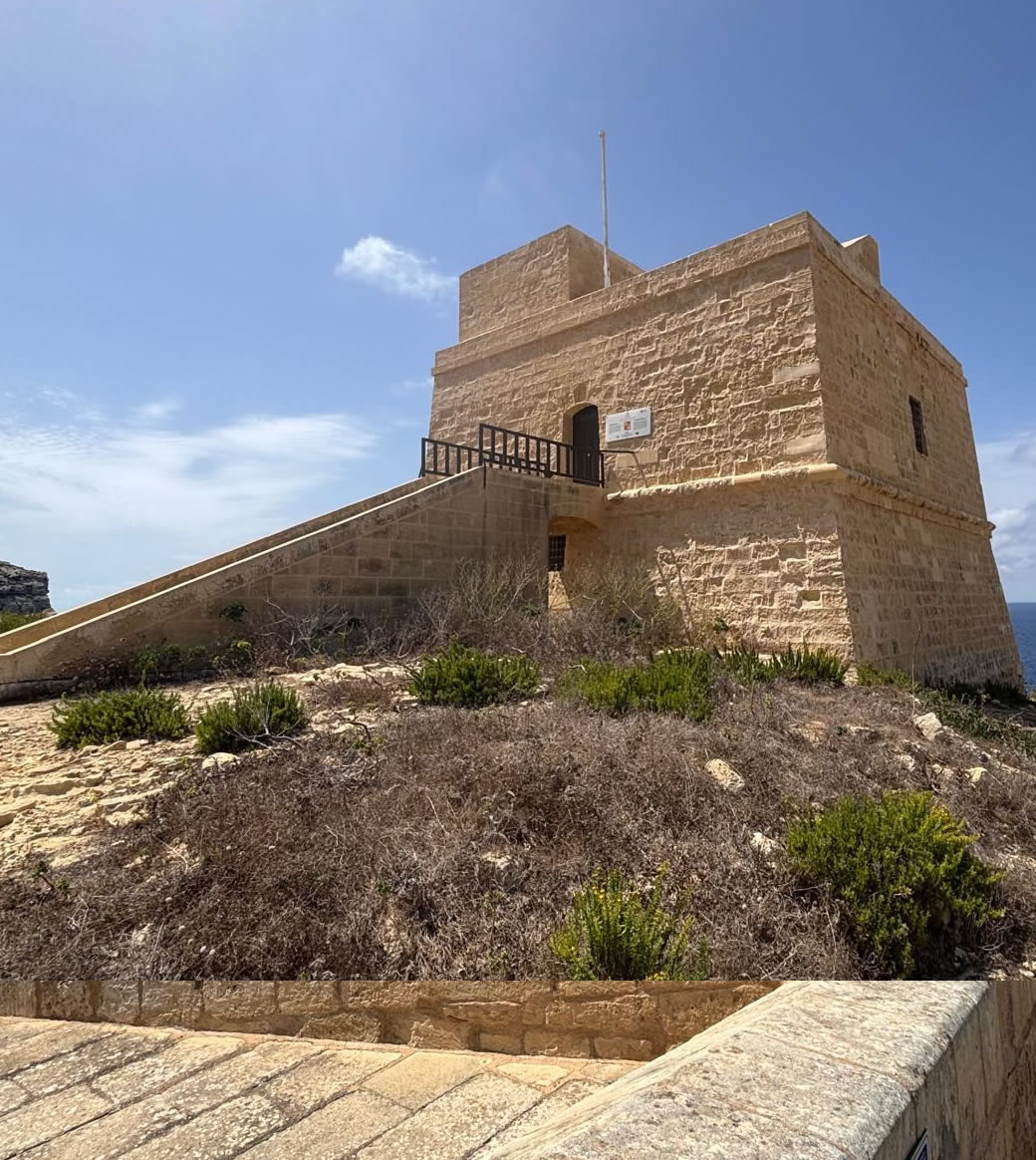
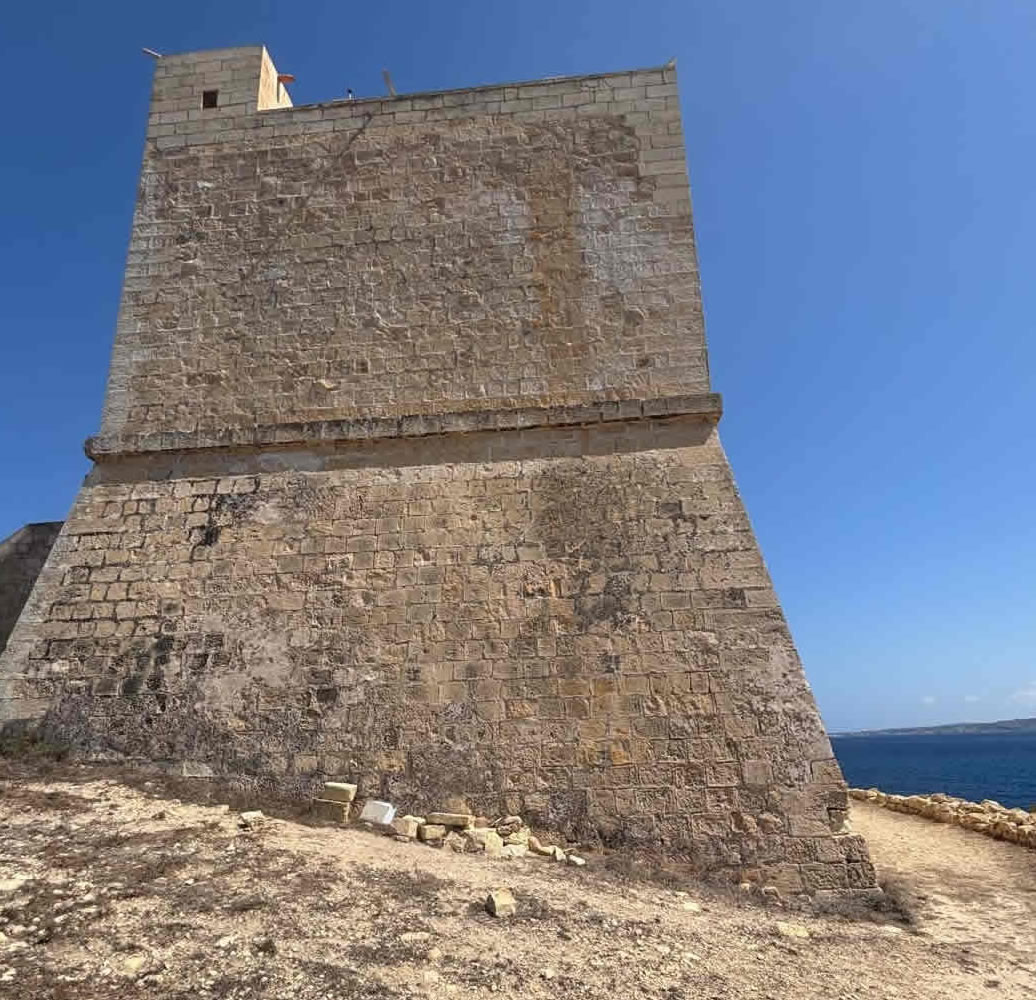
Gozo's coastal watchtowers
Gozo’s coastline is marked by a remarkable group of historic
watchtowers built during the time of the Knights of St John.
Their purpose was practical: to watch the surrounding sea, detect
approaching vessels and communicate warnings when the island was
threatened.
Four of the historic coastal watchtowers still survive at
Dwejra, Xlendi, Mġarr ix-Xini and Ta’ Isopu.
Together they form an important part of Gozo’s military and
maritime heritage.
The surviving towers
01
Dwejra Tower
Completed in 1652, Dwejra Tower guarded the exposed western
coast and the approaches around Fungus Rock. It later served
as an observation post during the two World Wars and has
since been restored.
Explore Dwejra Tower →
02
Xlendi Tower
Built in 1650, Xlendi Tower stands above Xlendi Bay and was
designed to guard the bay and watch the approaches along
Gozo’s south-western coast.
Explore Xlendi Tower →
03
Mġarr ix-Xini Tower
Completed in 1661, this tower stands at the mouth of the
secluded Mġarr ix-Xini inlet. It helped watch the Gozo-Comino
channel and served as an early warning post.
Explore Mġarr ix-Xini Tower →
04
Ta’ Isopu Tower
Also known as Sopu or San Blas Tower, this watchtower was
built in 1667 between San Blas and Daħlet Qorrot. In 1798
its guns were fired at the approaching French fleet.
Explore Ta’ Isopu Tower →
A warning system around the coast
The towers were part of a wider system of coastal surveillance.
Their elevated positions allowed watchmen to observe the sea and
communicate warnings to other defensive positions. The towers were
particularly important at a time when corsair raids and maritime
attacks were a serious threat to island communities.
The towers also had practical roles against smuggling and attempts
to evade quarantine. At Dwejra, for example, the tower was used for
coastal observation well beyond its original period of construction.
Dwejra Tower
Dwejra Tower was completed in 1652 during the rule of Grand Master
Giovanni Paolo Lascaris. It was built to strengthen the previously
exposed Dwejra coastline and was equipped by the Order with
artillery and ammunition.
The tower later continued to have an observation role. During the
First and Second World Wars it was again used as a coastal
observation post. Today the restored tower forms part of the
historic landscape of Dwejra.
Xlendi Tower
Xlendi Tower was built in 1650 during the reign of Grand Master
Lascaris. Its position above Xlendi Bay gave it a commanding view
of the bay and the approaches along the south-western coast.
The tower was originally armed and manned, with its position making
it an important part of Gozo’s coastal defence. It remained a
prominent guardian of Xlendi until the nineteenth century.
Mġarr ix-Xini Tower
Mġarr ix-Xini Tower was completed in 1661 at the mouth of the
fjord-like inlet. It was built at the expense of the Università
of Gozo and formed part of the defensive system watching the
channel between Gozo and Comino.
The tower was equipped with artillery and was manned by a
castellan and bombardier. Its elevated position gave the defenders
an important view over the inlet and surrounding waters.
Ta’ Isopu Tower
Ta’ Isopu Tower, also called Sopu Tower or San Blas Tower, was
built in 1667 by the Università of Gozo during the rule of Grand
Master Nicolas Cotoner. It stands between San Blas Bay and
Daħlet Qorrot and was the last of Gozo’s historic coastal
watchtowers to be constructed.
The tower has a particularly interesting later history. In 1798
its guns were fired at the approaching French fleet, making it
the only known Gozo watchtower to have taken such action. It was
restored in the early twenty-first century.
Lost towers and earlier defences
The four surviving towers were not the only coastal towers to
defend Gozo. Earlier structures included Garzes Tower at Mġarr
Harbour and the tower at Marsalforn. These were later lost, but
their existence forms part of the wider story of Gozo’s coastal
defence.
Garzes Tower was constructed at Mġarr in 1605, while a later tower
at Marsalforn was built in the eighteenth century. Their loss means
that the surviving towers are especially important reminders of
this earlier defensive network.
Visiting the towers
The towers are interesting not only for their architecture but
also for their locations. Dwejra, Xlendi, Mġarr ix-Xini and
Ta’ Isopu each occupy a different part of Gozo’s coastline and
provide a strong connection between the island’s military history
and its landscape.
Opening arrangements vary by site. Where a tower is open to
visitors, check current access arrangements before travelling.
Some locations also involve uneven paths, steps or exposed
coastal ground.
Frequently asked questions
How many historic coastal watchtowers survive in Gozo?
Four of the main historic coastal watchtowers survive:
Dwejra Tower, Xlendi Tower, Mġarr ix-Xini Tower and Ta’ Isopu
Tower.
Why were the Gozo coastal towers built?
They were used to watch the sea, detect approaching vessels,
raise alarms and help protect the island against threats such
as corsair raids. They also had roles in combating smuggling
and quarantine evasion.
Which is the oldest surviving coastal tower in Gozo?
Xlendi Tower, completed in 1650, is generally regarded as the
oldest surviving free-standing coastal watchtower in Gozo.
Dwejra Tower followed in 1652.
Which tower fired on the French fleet in 1798?
Ta’ Isopu Tower fired its guns at the approaching French fleet
in 1798. It is noted as the only known Gozo watchtower to have
taken such action.
Can I visit the towers?
Some towers are open to visitors on selected days or have
managed access. Check the current arrangements for the
individual tower before visiting.
Explore Gozo
Continue exploring Gozo's history, landscapes and places of interest.